Any gas, nano-sized, into water
AnyNble is a technology that breaks air or any chosen gas into bubbles of 50–250 nanometres and puts them into water — and the name of the bubbles it makes.
How is it different from microbubbles?
Microbubbles (tens of µm) rise and burst within seconds. Nanobubbles (50–250 nm) have almost no buoyancy and remain in water for days to weeks. Their charged surfaces attach directly to pollutants and algal cells, oxidising them or delivering oxygen.
Diffusion
Installed at one point, the bubbles spread by themselves through the whole water body down to the sediment.
Breakdown
Oxygen delivery decomposes organics in the water and the bottom sediment. Bubbles attach to algae and rupture cell walls.
Suppression
Conditions stay unfavourable for algae and pathogens. Only air is used, so there is no secondary pollution.
Algae sink; they do not float up
When nanobubbles contact algae, oxidation → sedimentation follows. SEM observation by Chungbuk National University (Prof. Cho Young-cheol's lab) showed many ghost cells (emptied cell shells) in the treated group and a lower concentration of inter-cell organics. These data are held by HWANGSAN under a technology-transfer agreement.
Unlike skimming scum off the surface, the surface stays clean after treatment and the bottom sediment shrinks with it.
Three gases, three results
I Air → water body restoration
Lakes, reservoirs, streams, seawater canals. Oxygen to the sediment removes the cause of blooms and odour.
II Oxygen → producing life
Fish tanks and irrigation. Higher dissolved oxygen prevents fish kills and increases root respiration.
III Plasma → advanced oxidation
Reactive species from underwater plasma ride the nanobubbles to oxidise refractory organics, bacteria and algae directly.
See below
Underwater-plasma advanced oxidation
A plasma generator creates reactive oxygen species in the water and the nanobubbles carry them through the whole water body. Oxidising power without chlorine or ozone dosing.
Source: HWANGSAN company & technology profile (2024.07) · KRC Rural Research Institute nanobubble advanced-oxidation treatment summary
Unmanned continuous operation
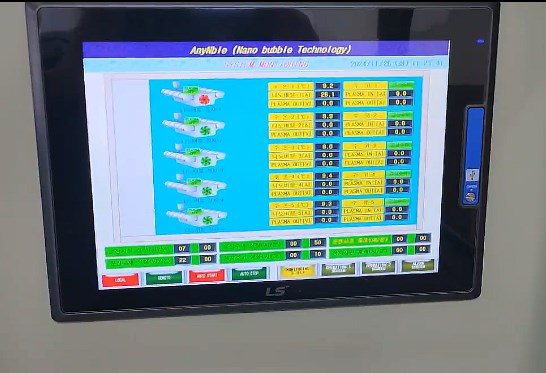
A remote monitoring HMI and automatic control panel read the water-quality sensors and run the equipment. No staff on site; after installation, maintenance is periodic inspection. The client receives a pre/post comparison report.
- Real-time water-quality monitoring · remote start/stop
- Scheduled operation (agricultural: 15 min every 6 h, etc.)
- No chemical dosing · minimal consumables
One principle; only the gas changes.
Tell us the site type and we will reply with the right gas and equipment combination.